


Explore NASA’s Jet Propulsion Laboratory: A Must-See Adventure!

Updated: Aug 4
NASA’s Jet Propulsion Laboratory (JPL) is a leader in robotic space exploration and one of the world’s most important Earth and space science research centers. JPL developed the first Earth-orbiting science satellite, created the first successful interplanetary spacecraft, and has sent robotic missions to study every planet in our solar system. Nearly every iconic NASA robot mission you can think of has been built at JPL, including Explorer 1, Voyager 1 and 2, and all those adorable Mars rovers.

You might think that a place like this would be strictly off-limits to the public, but that isn’t the case! You can get tickets to tour the site, where you’ll see actual working facilities, such as mission control and the spacecraft assembly room. And the best part? Tickets are FREE!
In this post, I’ll cover everything you need to know in advance of your JPL visit. I'll go over a little bit of background on the place, what you’ll see on the tour, and most importantly, how to get tickets and what essential details to know before you go. JPL is a secured government facility, so there are definitely some important things to be aware of prior to your visit. Let’s get to it!

Where is JPL?
The NASA Jet Propulsion Laboratory is located in Southern California, just outside the city of Los Angeles. The 168-acre JPL campus is found in the San Gabriel foothills above Pasadena and La Cañada Flintridge, not too far from the iconic Rose Bowl.

So whether you’re a SoCal local or are planning a fun vacation to the LA area, this is a unique stop to add to your list of things to do - just make sure you plan ahead! More on that at the end of the post.
A Brief History & Background of the Jet Propulsion Laboratory
JPL is federally funded by NASA, but it is managed by the nearby California Institute of Technology, known as Caltech (if you’re a Big Bang Theory fan, Caltech is the university that Sheldon, Leonard & the gang teach at).
(l) the Cahill Center for Astronomy and Astrophysics at Caltech (credit: Dhilung - Own work, CC BY 3.0, [https://commons.wikimedia.org/w/index.php?curid=8733538](https://commons.wikimedia.org/w/index.php?curid=8733538); (r) The cast of the long-running sitcom The Big Bang Theory, whose characters live in Pasadena and work at Caltech (credit: https://www.primevideo.com/detail/The-Big-Bang-Theory/0KAE4QF66FHX5XYK8Q7YE4X60P)
JPL’s origins date back to the 1930s, with Caltech students doing pioneering, albeit occasionally hazardous, experiments in rocket propulsion. For everyone’s safety, the students moved their work away from the Caltech campus to Arroyo Seco, a dry canyon wash north of the Rose Bowl. This eventually became the site of JPL, and the laboratory became a part of NASA in 1958.
(l) Students taking a break during 1930s rocket experiments; (r) The newly formed Jet Propulsion Laboratory of Caltech
That same year, JPL developed and launched Explorer 1, the first American satellite. Explorer 1 was the American response to the Soviet Union's success with Sputnik 1, and the success of Explorer 1 officially kicked off the U.S. Space Age. JPL has been leading groundbreaking space missions ever since!
(l) A Soviet Union stamp commemorating the launch of Sputnik 1; (r) A full-scale model of Explorer 1 being shown to the media at a press conference after the satellite successfully reached orbit
What You'll See On Your JPL Tour
There are 3 main stops on the tour: The Von Kármán Visitor Center, the Spacecraft Assembly Facility, and Mission Control.
Von Kármán Visitor Center
At the Von Kármán Visitor Center, named for JPL’s first director, Dr. Theodore Von Kármán, you’ll be led first into the auditorium. This isn’t just a theater space for visitors though - this is the room where all of JPL’s major press conferences dating back to the 1960s have been held. So, you’re being seated in a room that you’ve likely seen on TV over the years.

You’ll watch a short film that provides an overview of the laboratory's activities and accomplishments. Then your guide will add some additional detail and answer any questions. The edges of the auditorium are lined with models of some of JPL’s famous spacecraft. The guide will talk about all of them and the important role they played in space exploration. Some of the models include Voyager, Juno, and Cassini.

There is a small museum inside the visitor center, and you’re given about 15 minutes of free time to explore. The museum is organized by order of the solar system, starting with the sun. There’s a lot of cool stuff in here, with a full-scale model of Galileo as the big eye catcher. I also really loved seeing the scale models of Spirit and Opportunity, the twin Mars rovers who launched in 2003. Unfortunately, you don’t get a lot of time in here - I think we had about 15-20 minutes - so you do have to move through at a pretty quick pace in order to cover all the exhibits.
(l) exhibit wall inside the museum; (c) model of Galileo that occupies the museum's center; (r) a model of a Mars rover
Spacecraft Assembly Facility
The next stop is the spacecraft assembly facility where JPL builds and tests most of its robotic spacecraft. The Spacecraft Assembly Facility, or SAF, consists of two cleanroom workshops, called High Bay 1 and 2. We were escorted up to the High Bay 1 viewing gallery, where we had a bird’s eye view of the massive space. High Bay 1 is the larger of the two, built in 1961. It is 80 feet by 120 feet wide (24 x 36 m) and 44 feet (13 m) tall.

This room has been the assembly and test location for Voyager 1, Galileo, and all the Mars rovers. You can see logos for all the spacecraft that have been built here up on the wall of the workshop.

High Bay 1 and 2 are cleanrooms, which means they are designed to minimize the amount of unwanted airborne particles in the room. Spacecraft have to be as clean as possible to minimize the risk of any instrument or equipment failures, and of course to limit the risk of contaminating the places we visit with any Earth bacteria or materials. All employees entering the workspace must wear special clothing and follow strict protocols before entering.

While we weren’t lucky enough to see anyone actively working in the cleanroom that day, minus the one staged dummy worker, we did get to see a spacecraft in the process of being built, which was really cool. Our guide explained to us what they are building, while concept art of the project played on video screens behind us.

The future mission we were looking at is called ASTHROS - The Astrophysics Stratospheric Telescope for High Spectral Resolution Observations. Quite the mouthful! ASTHROS will be a high-altitude helium balloon designed for studying astrophysical phenomena. What does that mean? In a nutshell, the goal here is basically to study how living stars disperse and reshape clouds of gas and dust that may eventually form new stars.

ASTHROS will aim to fly for 3 to 4 weeks at an altitude of about 130,000 feet - that’s about 24.6 miles up (40 km). When fully inflated, the 40 million-cubic-foot balloon will be about 400 feet (150 m) wide, and the current estimated weight of the equipment the balloon will carry is about 5,500 pounds (2,300 kg). This will be the largest balloon mission ever attempted! When ready, ASTHROS will be launched from NASA's Long Duration Balloon Facility in Antarctica.

As of this blog’s publishing, there’s no official launch date on JPL’s website, but our guide mentioned that the launch goal was in about 2 years, so I guess we’ll see! I know I’ll be following this mission really closely when the time comes. Never thought I’d get excited about a high-altitude balloon mission, but that’s why being able to visit places like JPL is so important - it gets people of all ages excited about science and exploration.
Space Flight Operations Facility: Mission Control
The final major stop of the tour is the Space Flight Operations Facility, home to Mission Control. This famous building has been the site of so many great scientific moments that it is even designated as a national historic landmark!
You’ll head up some stairs to the viewing gallery that looks down on Mission Control from one floor up. Mission Control at JPL has been in continuous operation 24/7 since 1964. This truly is the beating heart of NASA’s deep space network, a worldwide system of antennas that communicate with interplanetary spacecraft.

Radio signals travel at the speed of light, so commands sent from here to spacecraft on our neighbor Mars can take several minutes to arrive, while signals from distant probes like Voyager can take over 20 hours to reach us. Mission Control isn’t just about outer space though, as JPL’s Earth-observation satellite communication takes place here as well. JPL does a ton of work in earth sciences, with satellites monitoring wildfires, drought, sea level rise, hurricanes, and atmospheric conditions.

The room adjacent to Mission Control is the Multi-Mission support area, or the MSA. This is where spacecraft flight teams conduct technical operations during critical, high-precision mission moments, such as landing one of the rovers on Mars.

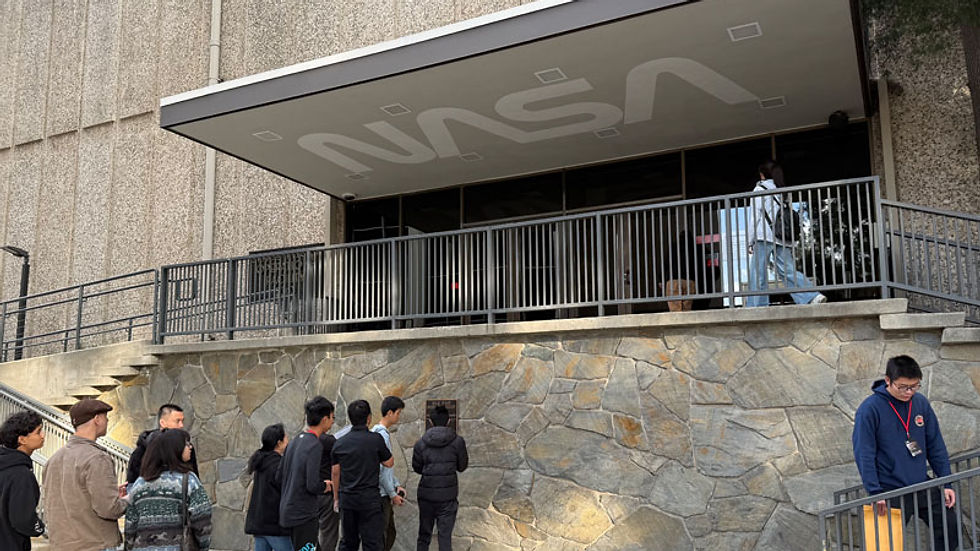
We got to spend a nice amount of time in the mission control viewing area before being led back down to the lobby. This is when you’ll have a few moments to take photos in front of the NASA JPL sign.

The Tour Continues...Online!
Lastly, I do want to mention their online tour - it’s really well done! While it doesn’t replace being able to visit JPL in person, it’s a fantastic way to see the campus from the comfort of home. Even if you are able to come in person, it’s still worth checking out, as the online tour shows a few additional locations that the in-person tour doesn’t.
How to Get Tickets
So how do you get tickets? The good news, as I mentioned earlier, is that they’re free! In today’s era where everything seems to cost an arm and a leg, it’s such a joy to have an exciting experience that doesn’t break the bank. The bad news? Tickets are hard to get. They’re in high demand, so as soon as they go live, they’re gone within minutes. Tour slots are released once a month on the JPL site, and must be booked a minimum of three weeks in advance. No last-minute tickets or walk-in slots are available.
In general, as soon as the tickets are released, you have to move quickly or they’ll be gone. Set reminders and an alarm! I had to try quite a few times before I was finally able to get 2 spots for my partner and me, so just keep at it if your first try isn’t successful - I promise the effort will be worth it!
Things to Be Aware of - Know Before You Go
There are definitely several things to be aware of before you get tickets to JPL, and before you head out for your tour.
Security: As JPL is an active federal facility and NASA research center, all tour attendees are subject to background checks in advance of the tour. That’s why there are no walk-in spots or last-minute booking options. If you aren’t comfortable with this (or have been a little naughty and won’t pass the background check…) then this tour probably isn’t for you.
Parking: There is plenty of free parking on-site at the visitor’s lot, which is directly across from the tour start point, the visitor’s center.
Restrooms & Shopping: Take care of any bathroom or shopping needs (the visitor center has a small shop) before the tour starts. We did not get an opportunity to shop at the end of the tour, as the store was already closed for the day.
Bring ID: You’ll meet your guide outside of the secured campus area, just off to the side of the visitor center building. The guide will take attendance and check IDs. You must bring your government-issued ID with you. All U.S. citizens over 18 must present a government-issued photo ID such as REAL ID or passport. All non-U.S. Citizens over 18 must show a passport or resident visa card. If you don’t bring the required ID, you won’t be permitted to join the tour. No exceptions.
Time & Distance: The tour itself lasts between 2 to 2 ½ hours, with a total walking distance of only about 0.8 miles. There are some stairs, but overall this isn’t a very physically demanding tour. The JPL campus itself is huge (it’s actually larger than Disneyland, to give you an idea of the scope), but thankfully the important spots for visitors are all pretty close together.
Weather: Tours do operate rain or shine, and while the main stops on the tour are inside, you will have to be out in the elements while moving from building to building. Pasadena doesn’t get a ton of rain, but have an umbrella on hand in case you end up going on a rare non-sunny day.
Freedom: You won’t have the freedom to wander off during the tour. You have to stay with the group and leave areas when told, no meandering off for snacks or bathroom breaks or lagging behind. Again, use the restroom before the tour starts, or while at the Von Kármán visitor center.
Cameras: Lastly, take your camera! I was surprised that they were allowed, but you can film and take all the pictures you want.


Comments