


Top 5 Hidden Gems in Egypt Every Foreign Tourist Should Experience

Egypt is famous for its iconic landmarks like the Pyramids of Giza, the temples of Abu Simbel, and the Valley of the Kings. These spots are classics for a reason and should absolutely be on every first time tourist’s itinerary. Yet beyond these well-trodden spots, the country also offers lesser-known sites and activities that reveal a different side of its rich history, culture, and beauty. For travelers eager to explore beyond the usual tourist spots, these hidden gems provide unforgettable experiences that many visitors overlook. Here are my top five hidden gem places and activities that will deepen your connection to Egypt and leave you with unique memories that will last a lifetime.
1. Mansheya Market District in Alexandria
Egypt’s most famous market is Cairo’s Khan El-Khalili, a sprawling 600+ year old bazaar located in the heart of old Islamic Cairo. It’s an essential part of any Egypt visit, as it’s a unique spot where modern Cairo blends into its medieval past. Definitely go spend some time here, whether to shop or to just walk around. Khan El-Khalili is famous for a reason.

Khan El-Khalili is also a complete sensory overload, jam packed with tourists and the savvy vendors who love (and occasionally prey upon) them. That’s why I recommend also checking out the markets of Alexandria. Unlike Khan el-Khalili, Alexandria’s markets are a mix of traditional souqs, street vendors, and European-style commercial streets. Alexandria has always been more cosmopolitan than many Egyptian cities because of its Mediterranean port location. Over the centuries, Greeks, Italians, Turks, Jews, Arabs, Armenians, and Egyptians have all influenced Alexandria’s architecture, cuisine, and commerce, resulting in a vibe that’s very different from Cairo - and much less touristed.

Mansheya is one of the oldest commercial centers in Alexandria. It sits near the old harbor and has been a trading hub for centuries, as Alexandria was Egypt’s main Mediterranean port. In Mansheya you’ll wander through narrow bustling streets, while browsing clothing and fabric shops, jewelry stores, household goods, street food vendors, and the occasional souvenir stall.

Why do I love this area? It can be noisy and crowded just like its famous cousin in Cairo, but this market is very local. You’ll be mostly wandering amongst other Egyptians, leaving the tourist hoards behind. I actually wandered through here on a rainy evening, and I’m pretty sure my travel buddy and I were the only tourists meandering through the stalls. Very cool experience.

2. Sunrise Balloon Ride Over Luxor
Luxor is quite possibly the world’s largest open air museum. The concentration here of ancient temples, tombs, and statues is unparalleled, and an Egypt enthusiast could truly spend a full week here and still not see it all. Modern Luxor is the site of ancient Thebes, the capital of Egypt during much of the New Kingdom period - the era of many of Egypt’s greatest pharaohs, such as Ramses II, Thutmose III, and my personal favorite, the female king, Hatshepsut.
We all grow up learning about the beautifully decorated tomb walls in the Valley of the Kings, and the treasures found in the resting place of the famous boy-king, Tutankhamen. Nearby Karnak Temple is one of the largest religious sites ever constructed. The avenue of sphinxes at Luxor temple is truly a sight to behold. While these are all glorious to visit and wander through, don’t forget to also check them out from above.

A hot air balloon ride in Luxor is an experience not to be missed. Drifting over one of the world’s great ancient civilizations in the soft light of sunrise is indescribable. It’s definitely the least “hidden gem” experience on this list, but many tourists skip it because that 4 am wakeup call to meet the ballon is a bit brutal, and in a country where most things are cheap by western standards, this experience is not. Don’t let the cost and the pre-dawn call time deter you. This was one of my favorite experiences in Egypt.

Can you go on a balloon later on in the day? Unfortunately, no. Flights are always at dawn, as this is when the winds are calmest, the temperatures are the most stable, and visibility is the clearest. Also, dawn and dusk provide the best natural lightning for photography, so all of those photos you snap will look beautiful.

Flights are also dependent on weather and do get canceled if strong winds or poor visibility hamper safety. I’d recommend booking the balloon ride early on during your Luxor stay so you have wiggle room to reschedule in case your flight gets canceled.
Last piece of advice on this: choose an established, well-reviewed company rather than going with the cheapest option you can find. Unlike planes, balloons cannot precisely steer themselves. Pilots mainly control altitude, while the winds determine direction. Balloon operators will tell you that companies are overseen by Egyptian aviation authorities and the balloons are all flown by certified pilots, but be sure to do your research before booking and boarding one.
3. Luxor Museum
In addition to the temples, tombs, and monuments, Egypt has countless museums to get lost in. The newly opened Grand Egyptian Museum (GEM) in Giza is the largest museum in the world dedicated to a single civilization and is now “the” museum to visit in Egypt. The former top dog, the Egyptian Museum, is the classic historic museum in downtown Cairo. While many of its treasures have now been rehoused in the GEM, the Egyptian Museum still holds countless priceless artifacts and maintains that old-fashioned, semi-chaotic-packed treasure-house vibe, a stark contrast to the ultra modern GEM.
Though not as famous, the Luxor Museum is actually one of one of the best-designed museums in the country, featuring a plethora of artifacts from the nearby temples and tombs of ancient Thebes. It’s also much less visited than the two mentioned above, and focuses on quality instead of quantity, so you have time to actually examine each artifact that you walk by without being surrounded by hoards of other visitors.

The Luxor Museum is known for being very carefully curated, using lightning, spacing, and storytelling in thoughtful ways to bring ancient Thebes to life. You won’t find crowded display cases here. In fact, many pertinent artifacts are housed individually in dark galleries, with a spotlight highlighting them in an almost theatrical manner. I adored this museum.

We went in the early evening, casually wandering the halls until closing. We had the place nearly to ourselves, allowing plenty of time for peaceful examination of what was on display. The storytelling aspect of the museum is also helpful for visitors who aren’t super familiar with the details of ancient Egypt’s rich history. Putting history into context always enriches the experience.
4. The Step, Bent, and Red Pyramids
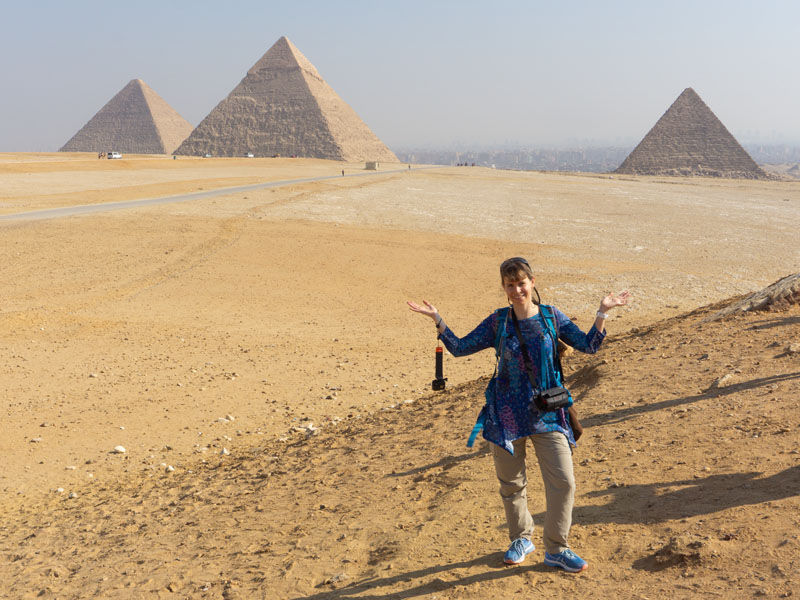
The pyramids of Giza are some of the most iconic archeological ruins you’ll find on earth. If you had only one day in Egypt, the Pyramids of Giza are absolutely where you should head. That said, Giza is also…a lot. The crowds, the heat, the constant verbal barrage of hawkers trying to sell tours, camel rides, souvenirs - it can be enough to send you back to your hotel screaming.

Let me introduce you to three other pyramids, who are just as amazing to explore, with much fewer crowds, cheaper prices, and no sensory overload! These three pyramids pre-date those at Giza - they were what came just before. This trio is historically fascinating because they are essentially the research-and-development phase of one of humanity’s greatest architectural achievements. Without these experimental pyramids, the later pyramids of Giza likely never would have existed.
The Step Pyramid of Djoser is located in Saqqara, an ancient royal burial area about 20 miles (30 km) south of Cairo. This pyramid is oldest large-scale stone building complex in the world. Before this was built, royal tombs were usually flat rectangular structures, so Djoser’s pyramid was actually the first major pyramid concept. It was a huge leap in engineering for the ancient Egyptians, and marked the beginning of monumental stone architecture. This Step pyramid was a literal stepping stone project on the way to figuring out how to built the pyramids of Giza.

The Bent Pyramid was the next attempt at pyramid engineering. Located at Dahshur, an ancient royal necropolis about 5 miles further south of the Saqqara area, it is one of the most visually interesting pyramids in Egypt because its angle visibly changes halfway up. Visitors here can actually see the trial-and-error engineering of the ancient Egyptians, as they attempted their first transition toward the smooth-sided pyramids that we see at Giza. The pyramid begins with a steep angle from the base and then clearly shifts to a shallower angle about halfway up to the top. Best guess from modern architects is that the original angle was too steep, perhaps leading to structural instability or cracking. Builders then compensated by adjusting the design mid-build in order to complete the project.

After the semi-successful Bent Pyramid experiment, ancient Egyptian engineers fully succeeded with the Red Pyramid, considered Egypt’s first true smooth-sided pyramid. Red because of the reddish limestone used in its core, this pyramid solved the problems found in earlier iterations. The angle was stable and the sides were smooth. It was the pharaoh Sneferu who had comissioned both the Bent and Red Pyramids. His son and successor, Khufu, comissioned the Great Pyramid of Giza, and the rest is history.
Another big plus of visiting the Bent and Red Pyramids? You can go inside them! Yes, you can go inside the pyramids at Giza as well (The Great Pyramid of Khufu is the one that is usually open to visitors), but it requires a separate ticket that is quite expensive, around $30 - $35 USD (as of 2026), and that’s on top of the $14.50 fee you pay just to enter the Giza necropolis. At Dahshur, entry to the Bent and Red Pyramids are included with your main ticket, so you’re only paying about $4 USD to crawl inside two pyramids, versus $45 for one pyramid entry at Giza.

Giza will also be infinitely more crowded. Despite the massive size of the pyramids, the tunnels that go into them are incredibly narrow. Imagine crawling through this with lines of sweaty people in front and behind you, with minimal air circulation. I’m not claustrophobic, but that seems like a nightmare. So not only are the Red and Bent Pyramids about 10x cheaper, they’re also much less crowded and provide essentially the same experience. You won’t really see anything too different inside a Giza pyramid than at one of the Dahshur ones. Back in this pyramid era of ancient Egypt, the Old Kingdom, there were no beautiful tomb paintings - those didn’t come until much later on in Egypt's history. So there’s not actually much to “see” in any of these pyramids, the insides are pretty empty - it’s more about the experience and adventure of crawling through the tunnel into the heart of the ancient structure. So if you want a cheaper, less crowded opportunity to squeeze yourself into a narrow 300+ foot long tunnel, go to Dahshur!

I've got a short video on crawling inside the Red and Bent Pyramids, which is also linked at the end of this post - it's useful to see this kind of experience on video before you try it, so you know if it is something you can or want to handle. It is very tight and stuffy in there, with no "emergency exits", so this kind of activity isn't for everyone.
5. Food & Fellowship - Meet Some Locals!
Egypt is one of those places where you have to work to seek out local interactions. As one of the top touristed countries in the world, you’ll nearly always be surrounded by tourist infrastructure, eating at tourist restaurants, following your guide, or brushing off hawkers. Yet behind the museums, monuments, tombs, and hotels, there are real people with a rich culture and deep heritage - go meet them! And the best way to bond with people and find out what a place is really all about? Food.
You’re not going to wander the streets of Cairo, meet a friend, and then get invited home for dinner. I mean maybe if you’re super social and very lucky, but for most of us having this type of experience will be an organized activity. That doesn’t make it less interesting or enriching though!
I did a dinner at a local family’s apartment - a husband, wife, and two kids. I helped her cook the meal a bit - I think I stirred the contents of a pot at one point, so I kind of helped the way a little kid would “help”, but hey, I still did a little something! We had dinner together, where they practiced English a bit and I tried my very basic Arabic skills, but we had a translator with us to help with communicating on more complex topics. After dinner, my hostess showed me her wedding album, and I tried to show off my awkward arabic handwriting. We played some music and danced around, and she fitted me up in a headscarf, since I didn’t know how to tie one properly.

It was an amazing night. I got to eat home cooked Egyptian food (which was uh, amazing), see the inside of an apartment, and laugh with some people I never would have met otherwise. It was one of my favorite moments of the trip, and was also a nice break from all the tombs and temples and museums.

So those are my top 5 hidden gems and unique experiences to make your trip a richer one!
Top 5 Hidden Gems In Egypt - Videos!
I've got a few videos on my Egypt experience, in case you want to check those out for more ideas on what to add to your itinerary.
My full 14 day experience in Egypt:
My top Egypt travel tips:
Inside the Bent and Red Pyramids:
Reading Hieroglyphs at the Egyptian Museum:
A tour of Abu Simbel:

Comments