


Bull Shark Diving in Playa del Carmen, Mexico - What to Know Before You Take The Plunge

When I tell people I’ve been diving with bull sharks, they typically tell me I’m crazy, and automatically assume I was in a cage. But here in Playa del Carmen, Mexico, you can safely get in the water with these beautiful apex predators, and watch as curious sharks chow down on provided fish while zipping by just a few feet over your head. In this post I’ll tell you everything you need to know about the Bull Shark Encounter dive, a 25 minute static dive experience where chain-mail clad dive guides offer fish to bring the sharks in close. Playa del Carmen is among the best places in the world to dive with bull sharks, as the warm water and excellent visibility allow divers to get up close and personal with these majestic creatures in an unforgettable, high-adrenaline, life-changing scuba dive.

A quick note on the photos you'll see: I did bring my camera down on the dive with me (read more about that here), but there is also a dedicated photographer that joins each dive (more on that here), and their photos came out way better than mine did, so the vast majority of the photos featured in this blog are from the Phantom Divers photographer. Even if you bring your own camera on the dive, I think you should still consider buying their photos - they can get shots of you during the experience, and get angles of the sharks that you can't due to the static nature of the dive.

Shark Diving With No Cage? How is this Safe?
Bull shark diving is actually quite safe when done responsibly. Bull shark diving safety comes from several things working together: experienced and professional guides, capable divers with proper behavior, strict procedures, and suitable conditions. Let’s dig more into it.

Bull sharks are often described as aggressive and dangerous because of their strength, adaptability, and constant presence in shark incident statistics. This part is true - bull sharks, along with tiger sharks and great whites, are one of the 3 most dangerous shark species. These 3 are responsible for the vast majority of fatal attacks on humans. So how the heck are we getting into the water with them without having major incidents?
Great White Shark Tiger Shark
The other two members of the naughty list: (l) the Great White Shark (photo credit Albert Kok - Own work, CC BY-SA 3.0, via Wikimedia Commons) and (r) the Tiger Shark (photo credit Terry Goss, CC BY 2.5, via Wikimedia Commons). Despite these species being the most common culprits in incidents, fatal shark attacks on humans are exceedingly rare.
Bull sharks are powerful, wild animals, and any dive with large apex marine life needs to be approached with care and caution. That said, “dangerous” does not mean they are actively interested in attacking scuba divers, or humans in general. These are very much not mindless man-eating monsters.

First off, humans are not on their menu, and this dive in high visibility waters, so the sharks can easily distinguish us from fish. The vast majority of shark attacks result out of confusion in shallow, murky waters, where the shark mistakes a human for something else. On your dive you’ll be in clear water, following experienced guides, and on the bottom of the ocean in a large group - the exact opposite of the conditions where most shark incidents happen. Bull sharks have no active interest in attacking divers. A human wearing a tank resembles nothing it eats, our gear makes weird noises and releases bubbles, and during these organized dives we aren’t fleeing from them —essentially, when we’re down there in a group at the bottom, we look nothing like their prey.

The dive is also extremely structured, and conducted in a way that keeps the sharks calm. You won’t be splashing around, swimming off on your own, or engaging in behaviors that might confuse the shark - this is a very controlled dive with rules in place to keep everyone safe. You’ll be instructed on exactly what to do, and following the instructions leads to a safe experience. The bull sharks here in Playa del Carmen move in calm, predictable patterns, and the feeder guides do also keep an eye on the divers and constantly watch the sharks. You’ll be down at the bottom under professional supervision and the shark feeders are well trained, follow a strict code of conduct, and are incredibly knowledgeable about shark behavior.

The type of sharks that frequent this site are also a factor in what makes these dives consistently safe. The sharks that arrive in Playa del Carmen each winter are overwhelmingly pregnant females, and pregnant bull sharks generally behave in less aggressive and more predictable ways than other bull sharks do. They have much lower testosterone levels during pregnancy, which is the hormone that drives aggression. Pregnant females also aren’t as ravenously hungry—it’s actually a biological mechanism to avoid cannibalizing their own newborn pups! —and they consume only enough food to survive. Marine guides in this area of Mexico have many years of observing shark behavior, and have consistently seen that resting, pregnant females in clear water tend to be docile, calm, and even more uninterested in divers compared to non-pregnant sharks during active hunting periods.

That said, obviously getting into the water with apex predators will always have a small risk attached to it, but as long as you respect the sharks, keep your hands to yourself, follow your dive guides, and stay calm, you’ll have a wonderful close encounter with these beautiful animals.
All About Bull Sharks
Bull sharks are commonly found across the globe in warm, shallow waters along coasts and occasionally even in lakes or rivers - they are euryhaline, which means they can thrive in both salt and fresh water! Might make you think twice before jumping into the water on your next lake house vacation :-) They can swim down to a depth of about 490 feet (150 m), but usually don’t go deeper than 100 ft (30 m).
Bull sharks are opportunistic apex predators who feed on many types of animals. Fish, turtles, marine mammals, and even other sharks are all on the menu. Females are often larger than males, coming in at an average of 8 feet long (2.4 m) and 300 pounds (130 kg), though particularly large ladies can get up to 11 feet long (3.3 m) and top 500 pounds (225 kg)! Males are slightly smaller, but still average nearly 7 1/2 feet (2.3 m) and over 200 pounds (90 kg).

As you’re likely aware, sharks of all kinds have faced threats from human activities. Bull sharks are currently listed as vulnerable on the International Union for Conservation of Nature (IUCN) Red list.
When is Bull Shark Diving Season in Mexico?
Bull shark diving season in Playa del Carmen, Mexico, is from November through March, peaking between December and February. Outside of that window the sharks are not in the area, and the dives do not run. February is the least busy of the 3 peak months in Playa del Carmen, so this would be my recommendation for visiting if you have an open schedule. December and January are busier, so you’ll have to make sure you book your dives far in advance. Do keep in mind though, as with any wildlife activity, there is no guarantee of sightings, but there is a strong seasonality of bull shark visits here that repeats year after year. The ocean offers no guarantees, but bull sharks in Playa del Carmen during the winter months is as close to one as you’re going to get.

Why do the Sharks Visit Playa del Carmen?
To answer this, I’ll circle back to two things I just mentioned: the sharks who frequent Playa del Carmen in the winter are mostly pregnant females, and bull sharks are able to live in both salt, brackish, and fresh water. In fact, these sharks actively seek out brackish water to gestate. Scientists aren’t sure why, but bull sharks like to give birth to pups in water that is mixed. This makes Playa del Carmen the perfect spot. The coast here sits directly above the Yucatán underground river system that formed the cenotes (definitely dive those while you’re in the area as well!).
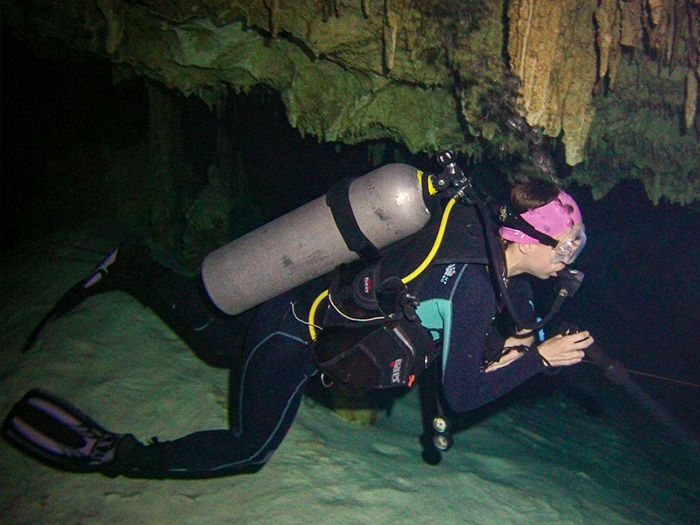
Some of that fresh water discharges directly into the ocean through submarine springs, resulting in the brackish water that the pregnant females love. This geological phenomenon is why the sharks come so consistently every winter, but don’t stay. This area is part of their reproductive cycle.

Who Can Do This Dive? Requirements to Dive with Bull Sharks
To join a bull shark feeding dive you must be a certified diver who is comfortable in the water, can control your buoyancy, and will follow instructions carefully, both before and during the dive. Bull shark diving is safe, but these are large, wild animals, and divers must always stay in the correct position, monitor their air, and descend and ascend quickly without assistance. Divers must also stay calm if a shark passes by closely - and they likely will on the feeding dives. If all this doesn’t sound like you, then hold off on doing this experience until you’re ready. (I’ll quickly note here that observational only, “non-feeding” dives are also an option - these are more akin to standard dives, and you can read more about these in a bit.)

Minimum 20 - 25 logged dives (depending on the dive shop), though I think a bit more experience is helpful. Some shops will allow you to go if you can pass a check dive beforehand, so they can gauge your skills and readiness, but this really isn’t a beginner dive. It’s a high-octane experience with unique conditions and strict rules. I personally wouldn’t have felt confident doing this dive with having only 20 under my belt, but that is the general minimum requirement.

Have experience and confidence in your skills Having dove recently (preferably in the last 6 months, certainly within the last year) is really important here. Bull shark diving is not the best place to rediscover that you have issues with buoyancy, mask clearing, equalizing, checking your air, or paying attention to a guide under water when there are many distractions. If you’re rusty, do a refresher dive before attempting this.

Make sure you have recently gone diving. Playa del Carmen and nearby Cozumel offer some of the best reef diving you'll find anywhere. Divers should be comfortable with deeper recreational dives. The bull shark feeding dive is a static dive that takes place at 80 feet. Some operators may require PADI Advanced Open Water certification or the equivalent. If you don’t have much experience at these depths, I’d hold off on doing this. This isn't the right environment to try your first deep dive.
Good air consumption is necessary. You go down with the group and go back up with the group. You’re never on your own schedule. Air goes faster at 80 feet than on a shallow reef dive. If you are an “air-sucker”, you’ll be putting yourself in a tricky position. Know your air consumption habits and don’t sign up for this if you’re a very heavy gas consumer.

You're very much down here as a group. Don't ruin the experience for others if you know you don't manage your air well. Photo Credit: Phantom Divers Good equalization techniques are also important to have. Again, you descend as a group, and don’t have the opportunity to slowly descend at your own pace as you would on a normal dive. This is a deeper experience than many reef dives, so if you have trouble equalizing, this might not be for you.
Divers must be able to descend without the aid of a rope. None will be provided, you’ll need to be able to drop down on your own.
I’ll mention staying calm and nerves once more, as this is critically important. Some nervousness before diving is normal - I still sometimes get a little nervous on reef dives! It’s also normal to feel especially excited or even a little intimidated before getting in the water with the sharks. They’re big apex predators after all! Having these feelings doesn’t necessarily mean you shouldn’t go. But there is a huge difference between normal nerves and uncontrolled panic.

You're getting into the water with one of the ocean's great predators! Have respect for them, but extreme fear isn't a recipe for a successful dive. You’ll be fine on the dive if you can listen, breathe slowly, stay with the group, and follow instructions. If you think you might bolt, swim away, ignore the guide, or lose buoyancy control, then you’re not ready. You know your own mind, body, and skills best. Don’t spend money on an experience you won’t enjoy, and don’t put yourself or others in a stressful situation that could turn dangerous.
About Phantom Divers
There are several operators in the Playa del Carmen area that offer “non-feeding” observational only dives, but only a few options if you want a dive experience where bait is used to attract the sharks. After doing my research, I settled on Phantom Divers. They’ve been around for over 25 years and have a ton of experience with both feeding and non-feeding bull shark dives. The dive center is located just a few steps from the beach, and only a short boat ride away from the shark diving site. They’ve got a swimming pool, showers, lockers, equipment rental, equipment storage, a boutique, and 5 dive boats specially built to operate in the Caribbean Sea.

Bull Shark Diving Options
Phantom Divers offers 4 options for bull shark diving experiences, including both feeding and observational only experiences. If you’re not sure which is right for you, I’ll touch on the ethics of each option a bit later on. Note: All prices and USD equivalents accurate as of October 2026.
Dive Experience: Bull Shark Encounter
Number of Dives: 1
Dive Cost: Starting from MXN 3,560 ($195 USD)
Rental Gear: MXN 440 ($24 USD)
Prime Photography Spot Fee: MXN 3,440 extra ($188.50 USD) note: only one spot available per dive
Number of Logged Dives Required to Participate: 20
Description: This is the dive experience highlighted in this blog post - the 80 ft static “feeding” dive where fish are used to bring the sharks in close. A high-adrenaline, bucket-list experience!

Dive Experience: Bull Shark Encounter & Reef
Number of Dives: 2
Dive Cost: MXN 4,420 ($242.30 USD)
Description: Combination of the Bull Shark Encounter described above, along with a morning dive on a local coral reef. The Mexican Caribbean features clear blue water and is home to the Palancar Reef. Even if the bull sharks are your main draw for diving in Playa del Carmen, the reefs here are lovely and worth exploring.
Dive Experience: Bull Shark Discovery
Number of Dives: 2
Dive Cost: MXN 2,180 ($119.50 USD)
Number of Logged Dives Required to Participate: None listed, but again, use your judgment. I wouldn’t do this as your first certified dive after passing your open water class. Have some experience at this depth, along with some experience drift diving before attempting.
Description: These non-feeding, observational only dives take place on a sandy bottom area at a depth of 60 ft. You will drift dive for 45 minutes while searching for the bull sharks that frequent the area. No bait or attraction is used, so you will see the sharks in their natural environment, free from any human interaction. This is a great option if you’re a concerned about the ethics of the Encounter dives, where the water is chummed - more on the ethics of the Bull Shark Encounter at the end of the post. It’s certainly worth discussing.

Dive Experience: SSI Shark Observer
Number of Dives: 3 (over the course of 2 days)
Class Cost: MXN 6,900 ($378.20 USD) without rental gear, MXN 7,780 ($426.50 USD) with
Number of Logged Dives Required to Participate: Open Water certification with 20 logged dives, or Advanced Open Water certification.
Description: This is a specialty course provided by Phantom Divers and recognized by SSI (Scuba Schools International). The course gives you a greater understanding of bull shark diving and teaches you to perform it in a safe and responsible way. You’ll learn the biology of the bull shark, and then do 2 discovery dives and 1 encounter dive. There is a final exam in order to receive the SSI Shark Observer certification.
Bull Shark Encounter: The Feeding Dive Experience - What to Expect, Step by Step
You’ll be throughly briefed at the dive shop before you head out onto the boat. Your dive leader will go over a lot of what I touched on earlier - listening to directions, staying calm, following the group, etc… They’ll review the depth of the dive, the descent and ascent plans, body positioning, hand placement, and all about shark behavior. This is not a dive briefing to zone out on. Pay careful attention. Make sure you understand what is expected, and ask questions if you're unsure on anything. The safest bull shark dives happen when everyone follows the same rules from start to finish.

You’ll get geared up at the shop before heading out. Keep in mind, if your personal gear has any bright colors, you’ll have to rent.

No bright colors or shiny objects are allowed on this dive, and full length wetsuits are required. All gear should also be streamlined to minimize anything dangling unnecessarily.

It's a short walk from the dive shop to the boat.The dive staff will assign you a spot to sit, and will provide you with weights. You will be intentionally overweighted. This is so you can quickly drop down to the bottom once you’re in the water. This is a deep, static dive, where you will spend all of your bottom time in one position, so the extra weight also helps keep you in place.

The ride to the dive site is only a few minutes. Once the dive leader gives the go ahead, you’ll drop into the water via back roll entry and descend as a group. Everyone stays together. There will be a fixed rope tied down across the bottom of the shark viewing area. Once you’re at the rope, you’ll lay down on your stomach, shoulder to shoulder with the divers on either side of you. You will not pass the rope, and will hold onto it for the whole dive. There is no swimming around during this dive, as the bottom time is 100% static. The rope is at 80 feet, and the group will have 25 minutes of bottom time.

Cameras are allowed, as long as you can maintain your proper positioning while using them. You’ll put your hands and camera under the rope, with the camera as low as possible. No extender sticks for Go Pros or Insta cameras are permitted.

If you have a professional camera setup with a tray and lights you can use it, but ask for those instructions before getting in the water. There will be a professional videographer on each dive, so if you don’t have your own camera you can purchase the videos and photos of your dive for $1000 MXN ($53.90 USD) once you’re back at the shop.

Once all divers are set up on the rope, the security divers will open the canisters of food they have brought down, and the sharks will quickly start to congregate! The security divers will be wearing chainmail suits for extra protection. There will be many sharks, and they will swim very close to you. Do not, under any circumstances, reach out to touch one. Hands should always be kept close to the body. You’re not here to chase, touch, provoke, or disturb the sharks. The goal is to observe them calmly and respectfully while maintaining the correct body position at the rope. Minimize movements during the dive, and any necessary motion should stay slow and calm. If any of the food falls near you, don’t touch that either. If there is fish uncomfortably close to you, signal one of the security divers to remove it.

As soon as the experience is over, you must follow the dive leader and ascend promptly, staying together as a group. No photos are permitted on the ascent, as the goal is to get out of the water as efficiently as possible. You’ll ascend at a rate of 1 foot per second, and there will be a 15 foot (5 m), 3 minute safety stop. Once at the surface, stay with the group and avoid excessive movements and splashing water - a calm demeanor must be maintained until you are completely out of the water. The boat captain will throw out a rope, you’ll grab ahold, and wait for your turn to climb back aboard.
Bull Shark Diving: Fun, But Is This Ethical?
You’re getting into the water with wild animals, which can have an impact on their behavior - it’s a lie to claim otherwise. While bull shark diving is an unforgettable experience, I do think it’s important to discuss the pros and cons of feeding vs non feeding dives, along with the ethics of even diving with them at all. Let’s dig into it.

Feeding vs. Observational - What’s the Right Choice?
The short, cop-out answer is that there are strong arguments on both sides. I chose the feeding dive, where trained professionals offer fish to the sharks to encourage them to come close, while the divers remain in a static position. On observational dives, the group will search the area for sharks, and maintain a farther distance as the sharks natural swimming patterns and behavior are on display. These observational dives can be more hit or miss. There will be great days where the group spots a half dozen animals, and days where none are spotted at all. Observational dives are genuine wildlife searches, and therefore will always include uncertainty of sightings.

In Support of Feeding Dives
Feeding dives are controversial, and not every diver wants this type of encounter, since it is a bit of a “show”, and the sharks also come in extremely close to the divers, which may not be everyone’s cup of tea. So why did I choose the feeding option? For starters, I was excited about the rare opportunity to have an intense encounter with these stunning creatures. They come incredibly close to you on a feeding dive, and it’s a thrilling experience to have a bull shark swim inches over your head. Doing this dive is perhaps a once in a lifetime opportunity, and feeding dives result in much more reliable sightings and close-up photography opportunities.
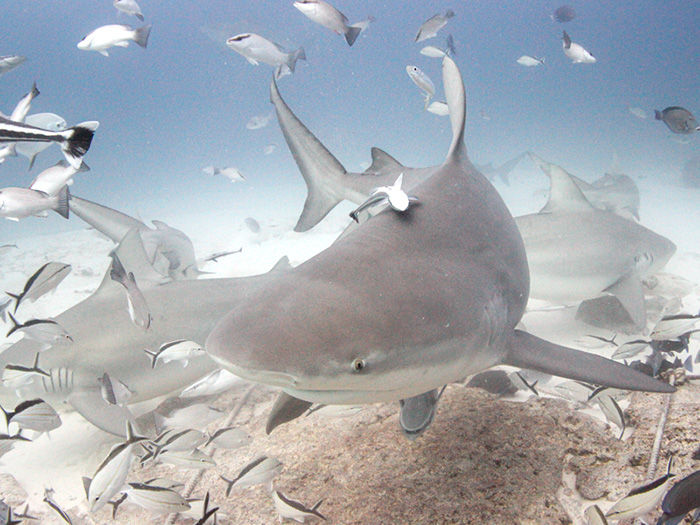
Isn’t feeding wild animals bad though? In general, yes. Proponents of the feeding dives will remind you that the amount the sharks get fed on these dives is an incredibly small percentage of what they need to survive, so these human provided “snacks” are not going to upset their natural feeding patterns. It’s like giving a person a couple of cookies, but they’re still on their own to go hunt down breakfast, lunch, and dinner. Proponents also note that studies have shown these dives don’t alter the sharks migratory patterns or encourage unprovoked aggression. The sharks come and go every year in Playa del Carmen, and the dives have an excellent safety record. There is no evidence that the sharks behaviors are being altered in any way by the feeding dives.

Supporters of shark feeding also question why chumming is condemned when used to observe sharks, yet remains acceptable in many areas where sport fishers use it to attract and catch sharks for killing. While shark feeding may not be an ideal practice, could its potential conservation benefits justify its use by helping people better understand, appreciate, and recognize the ecological value of sharks? Certainly all food for thought.
Critiques of Feeding Dives
Critics of the feeding dives argue that repeated feedings can nonetheless cause sharks to associate boat engines and humans with food, potentially altering natural behavior and causing safety risks for everyone involved. The feeding dives also are not true wildlife observation. It’s a staged show, where humans offer incentives for wild animals to behave in a certain way to entertain us.

Diver safety is also a concern. While no bull shark attack has ever been recorded in Playa del Carmen, these are large apex predators who can easily maim or kill, and the likelihood of this is obviously going to be higher when the sharks are being actively enticed by food. And, while very rare, there have been incidents where security divers have been bitten.

The source of food used in these feeding interactions raises another concern: the feeding practice may incentivize fishing specifically to supply shark dives with bait, potentially contributing to overfishing or encouraging the capture of species that would otherwise have little commercial value for human consumption. This can throw off the balance of the local ecosystem.
Shark feeding also involves sociocultural issues. In many societies around the world, sharks are viewed as religious or cultural icons, and locals often view the practice of feeding sharks for tourists as highly disrespectful.
So which is the “ethical” option? The correct choice on which dive style to select depends on what is most important to you, and what you're looking to get out of the experience.
Wait - Should We Even Be Diving with Bull Sharks at All?
Virtually all divers support the conservation of sharks, and many divers are thrilled to see them in the wild. These shark dives in Playa del Carmen were actually born from the conservation effort. Diving with bull sharks started as a way to help save the species, and the dives continue to provide an economic incentive to conserve them.

Years back, local dive operators partnered with the Mexican government to help restore Playa del Carmen’s bull shark population by reaching an agreement with local fishermen to stop fishing for the sharks. In return, the government issued licenses to select dive centers, permitting them to conduct shark-feeding dives. A portion of the dive operators’ profits was then shared with the fishermen to compensate for their lost income and provide a financial incentive to honor the agreement.
Over the years, as local shark populations rebounded, the area gained recognition as a premier destination for shark diving, attracting more and more dive tourists and generating economic benefits for the local community. When sharks attract visitors who spend money on dive trips, accommodation, restaurants, and other tourist services in the local community benefit financially from maintaining healthy shark populations. The living sharks generate recurring tourism income that now exceeds the one-time value of catching them. The recovery of bull shark populations means that during the winter months, divers have a high likelihood of encountering these sharks, whether they participate in a feeding dive or a non-feeding observational dive.

These dives also help change public attitudes. Many people encounter sharks primarily through frightening media portrayals. Observing sharks underwater can help divers understand their behavior and recognize that they are important marine animals rather than indiscriminate threats to humans.

These dives also continue to contribute to scientific conservation efforts. Dive operators can assist with shark monitoring, research, public education, and conservation funding. You may even see a shark tagged on your dive for future tracking!

So what’s the answer to this question? Should we be diving with bull sharks at all? I have my own opinion, but I’ll leave you to yours.
Bull Shark Diving in Playa del Carmen, Mexico - The Video!
Bull shark diving is one of those things that really needs to be seen to get a feel for it. There’s only so much words on a page can do to really give you a true sense of the experience. So to see what it’s really like to be underwater with these animals, check out the second half of my video on scuba diving in Cozumel and Playa del Carmen!


Comments