


Utah’s Secret Warm Water Scuba Paradise - Diving The Crater at Homestead

Updated: Feb 25
Did you know that the warmest scuba diving in the United States can be found in…Utah? Up until recently, I sure didn’t! Yes, this landlocked state, known for its snow, mountains, and skiing, takes the cake when it comes to warm water scuba diving in the USA, despite being nearly 700 miles away from the ocean. Welcome to the Crater at Homestead, a unique geothermal hot springs, home to mineral rich freshwater that maintains a very comfy 90-96 Fahrenheit temperature year round.

So whether you’re interested in diving, swimming, snorkeling, or just having a casual soak, the Crater at Homestead has something for everyone. Here’s everything you need to know about this unique Utah experience!
Where is the Crater at Homestead?
Open to visitors since 1996, the Crater at Homestead is located in Midway, Utah, in the Herber Valley. It’s an easy hour drive from Salt Lake City, and only about 30 minutes from the ski mecca of Park City. Imagine bundling up to hit the world renowned slopes of Park City in the morning and then scuba diving in 95 degree water in the afternoon!
The Crater at Homestead is located on the site of the Homestead Resort, a luxury property offering cozy accommodations, unique dining, and heated pools. 2027 will bring the addition of a spa, along with the re-opening of their redesigned championship golf course. There are lots of updates currently happening on the property! You can come to the crater just for your swim or dive experience, or book a room here to enjoy the area for a longer vacation.

What is the Crater at Homestead? How Did There Get to be a Scuba Diving Site in the Middle of Utah?
The 55 foot high limestone dome that surrounds the swimming hole is estimated to be around 10,000 years old.

The dome was created slowly over time, when snow melt from the nearby Wasatch Mountains would seep deep into the earth and then remerge at the surface, having collected minerals during the course of the journey. This now mineral-rich water would slowly deposit sediment, and over thousands of years the dome structure took form and grew into the beehive-like shape that we see today - quite fitting, as Utah is the beehive state!

The water comes into the crater through an aquifer, heated by the earth’s interior, at a rate of about 135,000 gallons per day - so the water in the crater is always clean, warm, and constantly being refreshed. You can expect a water temperature in the low to mid 90s. When I dove, my dive watch recorded 93 degrees Fahrenheit. Oh, and the best thing about the geothermal springs at Homestead? They’re not volcanic, so there is no unpleasant sulfur smell to deal with :-)

How Big is the Crater at Homestead? How Deep Is it?
The dome is about 55 feet high and 400 feet wide at the base. The water in the crater goes down to a depth of 65 feet, with an 8 - 14 foot layer of thick silt covering the crater floor. There is a small hole in the ceiling of the dome, which lets in some natural light and air.

What if I Don't Dive?
This post focuses primarily on the scuba experience, but there are plenty of other fun activities in the crater as well. You can go swimming, snorkeling, relax in the “hot tub” soaking area, or even take a stand-up paddle board (SUP) yoga class. We’ll touch on these other activities in a bit!

Activity Details For the Divers: Scuba Diving Information
Scuba Hours of Operation
Weekdays: 12:00 p.m. – 8:00 p.m.
Weekends: 10:00 a.m. – 8:00 p.m.
Do I Need to be Certified to Dive at the Crater at Homestead? Can I Get Certified if I Am Not?
Yes…and yes! In order to go for a “fun” dive at the crater you do need to be certified, but classes are offered if you’d like to get your certification here. Just email the dive team at thecrater@homesteadmidwayutah.com. Something to keep in mind though, if this is your first scuba experience: all other water you’ll ever dive in after this will be colder :-).
I’m a Certified Diver. Can I Dive Alone? Do I Need a Guide to Dive the Crater?
In order to dive here on your own (not as part of a class), you do have to be buddied up - no solo diving is allowed. No buddy to dive with? No problem. For an extra fee you can hire a dive guide to dive along with you.

I ended up needing to do this, as my partner doesn’t dive. I really liked having the guide though. The crater isn’t huge so you can’t really get lost in it, but I enjoyed having a guided tour of the cavern so I didn’t miss anything down there - there are lots of cute fun objects underwater to see and play with!

Do I Need to Bring My Own Gear or Can I Rent?
You can absolutely dive in your own gear, but there is an on site activity center that offers rental equipment if you need. I didn’t want to bring all my gear on the flight to Salt Lake just for one dive, so I rented for the extra fee. The rental gear is nothing fancy and has certainly seen better days, but it will get the job done!

As for a wetsuit, you really don’t need one. If there was ever a dive to just strap that tank to that BCD and head on in, this is it! Two things you should bring though:
1) If you have an underwater flashlight, take that along. There isn’t a lot of natural light in the crater, so it does get dark as you descend.
2) Towels for drying off and/or keeping warm post-dive. The water will obviously be warm, but the air temperature certainly won’t match. I dove in the winter, and while the air temperature inside the crater was considerably warmer than outside, you will be chilly after you come out.
What Will I See Underwater?
The water here is pretty clear, with visibility usually around 35 - 40 feet, though as mentioned above, it does get quite dark toward the bottom of the crater. I’ll start off by mentioning what you won’t see, as you may already be wondering - aquatic life. No fish or turtles here, at least not live ones :-) The one thing the crater does have plenty of are toys and obstacles to swim around. There’s a plastic alligator, a turtle, a crab, a skeleton, piping shapes to swim through, etc…
(L) An underwater skeleton attached to a giant wheel; (C) Underwater piping - I practiced some scuba somersaults with these; (R) A plastic crab hanging out on the wall - he looked pretty real!
There is also a submerged platform, which you can use for whatever you like. If you go with a guide, they can show you the gap in the wall where the water exits the crater, so you can feel the suction. Of course you can also explore the underwater geology of the structure, working your way around the sloped crater walls formed by thousands of years of mineral deposits.

While the crater floor isn’t very deep, you are asked to stay well above it. As I briefly mentioned earlier, there is a very thick layer of silt at the crater’s floor. If a diver with bad buoyancy gets too close to that massive amount of silt, the visibility will be ruined for everyone else.
How Long Can I Dive?
Dive slots are 1 hour in length. Your hour allotment does include equipment set-up time. You’ll go down with a full tank, and the crater isn’t very deep, so unless you have terrible air consumption you’ll have plenty of time to explore within the allotted timeframe.
Anything Else I Should Know About This Site?
This isn’t a “full service” type of dive experience. You’ll be expected to know how to put together your own gear, although you can certainly ask for help if needed.

Once you’re ready to go, getting into the water is nice and easy. There is a separate section of the pool for diving entry with a ladder and submerged platform, so you can finish your preparations away from the swimmers.

Keep in mind that you are up in the mountains, not at sea level - this is an altitude dive. Scuba diving at the Crater at Homestead is done at approximately a 6,000-foot elevation. If you have a dive watch that can be set for altitude, be sure to adjust that setting prior to diving in order to have accurate data. At this altitude, it is recommended to ascend no faster than 20-feet per minute. Again, this is a relatively shallow dive, but do keep in mind the altitude factor in order to stay safe. Check out this article to learn more about altitude diving. PADI also has a course, if you want to get into altitude diving as a specialty.
What Are the Costs for Scuba Diving at Homestead?
I went diving in January 2026, and the prices below are what I paid. These are, of course, subject to change, so please reach out to thecrater@homesteadmidwayutah.com to confirm current pricing, as scuba prices are not currently displayed on their new website. Homestead Resort recently updated their page, which looks great, but they unfortunately took down a lot of the detail on their scuba and gear rental pricing. Hoepfully that will get re-added at some point. The older site wasn't as "polished" a look, but had better information.
Certified Diver - 1 Hour Dive: $40
Instructor Guide Add-On: $50
Gear Rental: $10 per item (BCD, Tank, Reg, etc…)
Activity Details For the Swimmers: Swimming Information
Soaking / Swimming / Snorkeling Hours of Operation
Weekdays: 10:30 a.m. – 9:30 p.m.
Weekends: 9:30 a.m. – 9:30 p.m.
How Long Can I Swim For?
Sessions are 1 hour in length, with about 40 minutes in the water.
What Am I Allowed to/Not Allowed to Do in the Water?
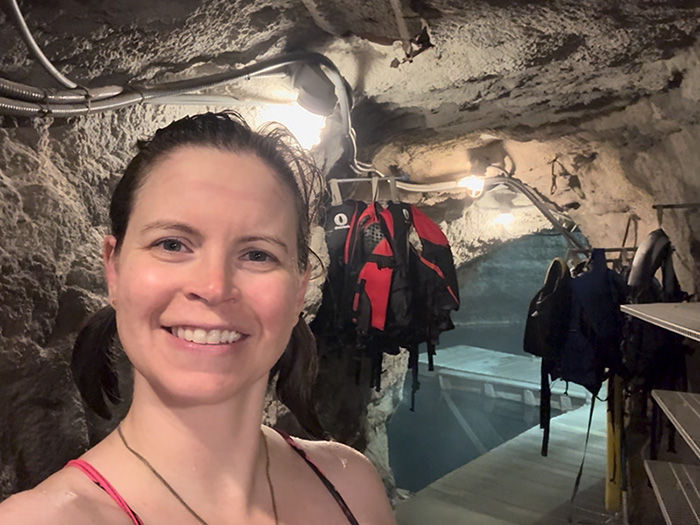
Everyone has to wear a flotation device while swimming. You can bring your own marine-grade life jacket if you have one, otherwise a wide variety of sizes are available to borrow.
There are platforms with ladders for easy entry into the water. There’s no jumping or diving off the platforms, nor is freediving allowed. If you want to go deep under the water, you’ll have to book scuba instead :-).
You can bring a snorkel and mask to get a bit of an underwater view though, and if you don’t own they can be rented at the activity center for a small extra fee. You can watch the divers this way from up above!

Inside the activity center. Rent your masks, fill out waivers and sign up for activities here Swimmers of all levels are welcome, but keep in mind that there is no lifeguard on duty.
You can bring your phone or a small waterproof camera in if you want to film or take photos, and you can swim/float around the entire area.
You can also just sit and relax if that’s your jam! There’s a “hot tub” soaking area that’s built in next to the entry platform, so if you want to just hang out and sit in the warmth the whole time, that’s also a wonderful option.

Yeah, I could easily spend an hour here.
What are the Costs for Swimming / Snorkeling / Soaking at Homestead?
A 1 hour swim or soak is $28 as of early 2026. Mask/snorkel rentals are $10. If you decide you want a mask and snorkel, book at the activity center before heading into the crater.
Activity Details for the Yoga and Stand Up Paddle Boarders: SUP Yoga Information
If you’re looking for a unique way to experience the crater, Park City Yoga offers a 1 hour Stand Up Paddle Board Yoga class in what they call “the oldest yoga studio in the world”. You can fill out a booking inquiry to find available dates, and watch a video of a class here to get an idea of what the experience is like. As of February 2026 classes are 2 people at a minimum, with a maximum of 13 participants. A 2 person class is $225 per person, and 3+ is $145.
Activity Details For Everyone: General Information
The crater area is small and all activity bookings are strictly organized by time slot, so you won’t be let in until close to your reservation time. You’ll wait outside the crater door until a staff member comes out to check you in. So no sense to get here too early, as you won’t be able to hang out inside.

Not allowed in until the start time! Use the restroom beforehand, as it is located a minute or two walk outside the crater, next to the activity center. Once you’re inside the crater area, there are no facilities. There are no showers available either, but the crater water is fresh and not smelly, so you’ll be ok until you get home to clean off :-)
There is a 48 hour cancellation policy. If you need to cancel your reservation you must contact the office before that window to receive a refund. A processing fee of $2.50 will automatically be retained from your original payment amount.
There are 4 basic changing vestibules (think bench and a wooden door) inside the crater, but it’s much more efficient if you arrive for your reservation with your swimsuit already on. The more time you spend getting ready (or waiting for a changing stall to open up), the less time you have in the water!

Changing areas are basic, but here if you need them. Come in your bathing suit. Lockers are provided, but not locks, so they are for storage, not security. If you have valuables you want to safeguard, I’d recommend either bringing your own lock or leaving them in your car, whichever feels safest to you. I put my wallet in my bag and just put it in the locker, but everyone has a different level of comfort when it comes to valuables, so do what feels best for you.

There are also a few shelves near the entrance to the swim area, for things like towels, water bottles, and shoes. Just don't leave anything here you don't want potentially getting wet.

Don’t forget to bring a water bottle! Swimming and diving are both tiring activities and you’ll want to stay hydrated. No food or drinks allowed in the crater area otherwise.
Final Thoughts on Scuba Diving at the Crater at Homestead?
This is such a fun, unique experience, especially to do in the winter. I had no idea scuba diving was an option in this part of the country, let alone discovering that Utah is home to the warmest water dive site in the United States! If you’re a diver, it’s a great bucket list dive and a fun site to share with other divers - I’ve very much enjoyed telling people I went scuba diving on my long weekend in Salt Lake City.

Even if you don't dive, swimming here is also such a pleasant experience. While I was underwater, my partner spent a relaxing hour floating in a geological wonder - it was a win-win activity for both of us!


Comments