


Old Bethpage Village Restoration & Living Museum: Where the 19th Century Comes to Life!

Did you know you can still visit and experience 19th century Long Island? Welcome to Old Bethpage Village Restoration, a living history museum where you can step back into farm village life of 1800s Long Island. Located just 35 miles from midtown Manhattan, this 209 acre recreated pre-Civil war village transports visitors back to a simpler time. Open since 1970, the village features over 2 dozen historic homes from across Queens and Long Island, painstakingly moved here and meticulously cared for by skilled craftsmen, in order to preserve each of their unique histories.

Costumed volunteers inject life into the place, manning the bar at the tavern, holding down the fort at the local school, and demonstrating 19th century skills and trades. So if you’re looking to see what Old Bethpage Village Restoration has to offer, are interested in demonstrations of historic trades, or are prepping for an upcoming visit, then I invite you to journey back in time with me as I spend a lovely afternoon living and breathing Long Island’s rich past.

Location
Old Bethpage Village Restoration is located in Old Bethpage, New York, right on the border of Nassau and Suffolk counties. It’s a doable day trip from NYC, but you will need a car to get here.
Hours of Operation & Ticket Prices
Days Open: Friday - Sunday
Opening Hours: 10:00 am - 4:00 pm
Last admittance is 2:15 pm, though if you arrive that late you’ll have to rush. I would recommend 3 - 4 hours to enjoy the village without feeling stressed about time.
Ticket prices (as of December 2025) are $15 for adults, $12 for Seniors, $12 for children aged 5 to 12, and free for children aged 4 and under.
Parking
There is a large, free parking lot at the end of the long driveway, very close to the visitor's reception center and village entrance.
What to Bring
There are a couple of vending machines in the reception center, but I’d recommend bringing your own snacks and drinks. The village itself doesn’t have much in terms of food to purchase. You’ll be outside much of the time, so weather appropriate clothing is a must. There is some shade, but also plenty of sun-exposed areas. The paths are easy to walk on, so no special footwear is required, but the site is very large, so wear shoes you’re comfortable walking in. You’ll be on your feet nearly the entire time.
Exploring Old Bethpage Village Restoration
The Reception Center
This modern building is where you’ll start your tour, buy your tickets, and receive information on the village, including which buildings are currently open to the public - this can vary depending on the availability of staff and volunteers, but you can always call ahead to check. There were plenty of buildings open when we visited on a very hot and slow summer afternoon.

The reception center also houses a small museum, where you can learn a bit more about the history of 19th century Long Island, and it provides some detailed background on each of the historic buildings that you’ll pass by on your visit. Definitely spend at least 10-15 minutes in here before you head out.

Don’t forget to grab a map before leave! The paths are easy enough to follow, but there’s no signage on a recommended order to the visit. The map is very useful to know which building you’re looking at, as well as to make sure you don’t miss anything. There’s really no one way to explore the site, and though we ended up seeing the buildings very out of the map sequence, I will list them here in the order that they appear on the map.
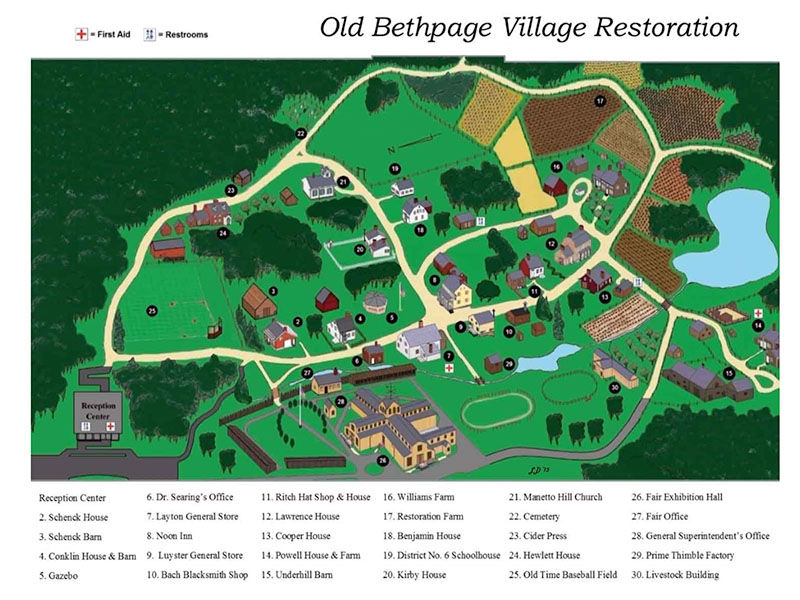
Once you’ve grabbed your map and have taken care of any bathroom, snack, or water needs, it’s time to head on out into the village!
When walking into the village from the reception center, you’ll come across the Schenck House and its accompanying barn, right near the baseball field that we’ll touch on later. Schenck House is one of the oldest remaining Dutch farmhouses in the entire United States. It was built between 1730 and 1760, and the house originally stood on a 300 acre farm in Manhasset, about 17 miles west from where it is today at Old Bethpage Village.

Conklin House & Barn (Map #4)
Just a drop farther down the road from the Schenck House is the Conklin House and barn. This white cottage was built in 1830 and originates from Village of the Branch, about 17 miles east of Old Bethpage. The house is named for its owner, Hull Conklin, who bought the home in 1853 for a grand total of $600. That’s about $25,000 in 2025 US dollars. Imagine buying a home in the NYC suburbs today for only 25 grand!

Gazebo (Map #5)
Next to the Conklin House you’ll find a modern gazebo. I couldn’t find any additional information about it, so not sure if it has any historical significance - might just be a modern event space or meeting point. In any case, it is a very nice spot to rest at and get out of the sun on a hot summer day!
Dr. Searing's Office (Map #6)
Across from Conklin House is a small red and white building, Dr. Searing’s office. This was the first building on our visit that was open so we could go inside. Built in the very early 1800s, it originates from Hempstead, about 15 miles to the southwest of Old Bethpage. Named for its earliest recorded owner, Dr. James Searing, the good doctor’s office has the distinction of being the final building moved to Old Bethpage Village Restoration - it arrived in April 1993. The interior is a recreation of what Dr. Searing’s office may have looked like.

Layton General Store (Map #7)
Just down the road from the doctor’s office is one of the highlights of Old Bethpage, the Layton General Store. Built in 1866, this structure comes from East Norwich, about 10 miles northwest.

The John M. Layton Grocery & General Store was both a mercantile and residential property, as the successful Layton merchant family lived upstairs. This building is a full experience, with stocked shelves, some small items to purchase, and costumed guides who can answer all your questions about what life was like for the Layton family in the mid 19th century.

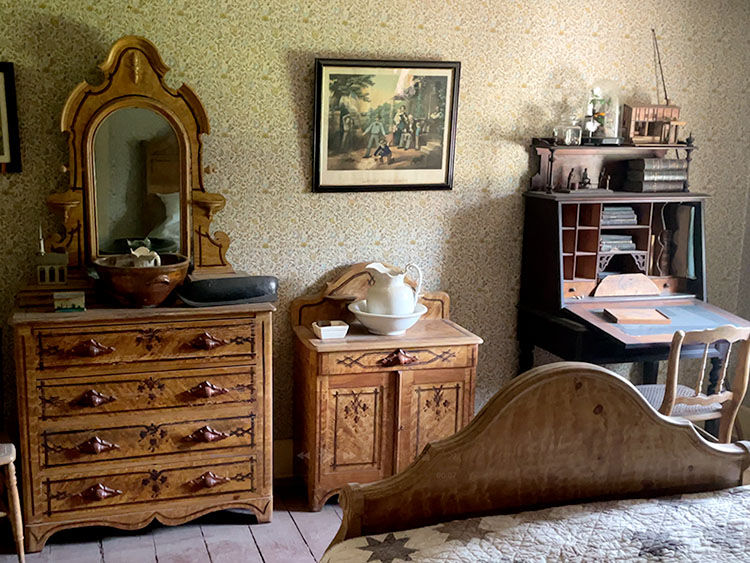
The shop itself can take a lot of time just to examine all the historical goods in stock on the shelves - there’s so much to look at if you’ve got a curious and detailed eye. Once you’re done with the business portion of the property, you can head upstairs into the Layton family's living quarters. It’s a beautiful recreation, and really allows you to visualize what life may have been like for these successful merchants living and working in East Norwich, Long Island, 140 years ago. Definitely take your time with this property, it’s a gem!
Noon Inn (Map #8)
A bit farther up the road is the Noon Inn, another highlight of the village. This Georgian style two story home was built between 1831 and 1843, and originated in East Meadow, about 9 miles to the southwest.

You can still have the tavern experience here, as water, birch beer, root beer, and some snacks are available for purchase - cash only of course, credit cards and Apple Pay didn’t exist in 1843! In addition to selling you a cool drink, the barkeep can answer all your questions about the property and its history. Upstairs you can walk through the recreated living quarters of the home.

Luyster General Store (Map #9)
Across from the Noon Inn, Luyster General was built in the early 1800s and originates from East Norwich. It has 3 vertically stacked doors at the back, to accommodate all the deliveries a busy general store would have received.

Bach Blacksmith Shop (Map #10)
The Bach Blacksmith Shop is a typical one room shop that was found in nearly every village of its time. Built in the 1870s, it comes from Hicksville, about 7 miles to the west. The shop is named for the owner and blacksmith, William Bach.

Ritch Hat Shop & House (Map #11)
Thankfully during our visit the shop was open and the resident hatter was in, which was such a delight! He did a lengthy demonstration for us on how a hats were made in the 1800s.

The accompanying Cape Cod style home belonged to the hatter Louis Ritch. It was built in 1813 and both the shop and house come from Middle Island, about 32 miles to the east of Old Bethpage. While standing next to each other today at the village restoration, back in their original location they were actually situated a few miles apart.
Lawrence House (Map #12)
The large home next door to the Ritch properties is Lawrence House. This was a really nice one to tour and also had a costumed volunteer on site to provide background information. I found this building to be really fascinating because it comes from College Point in Queens, which is a couple of towns over from where I grew up.

The home was bought in 1774 by farmer and real estate man Leonard Lawrence, and this beautiful property remained in the family for the next hundred years. When the home eventually made the 25 mile journey from Queens to Old Bethpage, it had to be dismantled and meticulously put back together once it reached the village.
Cooper House (Map #13)
Cooper House is an interesting stop, as it was owned by the famous industrialist, inventor, and philanthropist Peter Cooper, who founded Cooper Union, a well known college on the edge of Manhattan’s East Village. The house dates all the way back to 1660, but under Peter Cooper’s ownership it became what we see today at Old Bethpage.
New York's Cooper Union and it's founder, Peter Cooper
The first section of the house was built around 1750 by Joshua Powell, and it is the only building that is original to this location. Powell House is still a working barnyard today, complete with animals and pastures. The original house was expanded upon several times during its history, with this current version restored to the way it would have appeared when the owner’s grandson, Richard S. Powell, lived here.

Across the road, Underhill Barn was constructed in the English style and dates back to 1750, originating in nearby Syosset, about 6 miles northwest of Old Bethpage.
Williams Farm (Map #16)
Named for Richard Williams, this farmhouse heouse dates to 1820 and originally comes from New Hyde Park, about 17 miles to th west.
Restoration Farm (Map #17)
Restoration Farm is a 7 acre working farm dedicated to sustainable agriculture, located in the back of the village. They are also open to visitors, and you can find out more about their farming methods, programs, and community events on their website!
Benjamin House (Map #18)
Benjamin House was also open and had a volunteer inside to answer our questions about the history of the property. The house comes from north fork of eastern Long Island, about 50-60 miles east of Old Bethpage - that’s quite far away! The Benjamin family were amongst some of the earlier settlers on Long Island’s north fork. This property had an outhouse you could explore as well - made me grateful to live in the 21st century!

District No. 6 Schoolhouse (Map #20)
This one room schoolhouse was probably my favorite stop of the day. I find learning about schools and educational methods of the past just fascinating. The costumed volunteer here was enthusiastically in full character, and he really brought everything to life. He was sitting on the porch in a rocking chair, reading a copy of a newspaper from the 1800s when we arrived. Built in 1826, the schoolhouse comes from Manhasset. It is only one room, so students of all ages were taught here together, as was common back then. Final classes were held here in 1868.

Kirby House (Map #20)
Kirby House is a classic Greek revival style home, built in 1839 in Hempstead. The house is named for its owner, Richard Kirby, who was a tailor.

Manetto Hill Methodist Episcopal Church (Map #21)
Up the road from Kirby House is Manetto Hill Methodist Episcopal Church. The church is a significant stop here, as it was the very first building moved to the village restoration. Built in 1857, the church comes from neighboring Plainview, which is the next town over from Old Bethpage. The building wasn’t open for entry, but the dutch door was open so that we could peek inside.

Cemetery (Map #22)
Up the road from the church is an old local cemetery, which we spent a few peaceful minutes walking through.
Cider Press (Map #23)
A bit farther down the road from the cemetery we passed an old cider press. It was not open, and I couldn’t find any additional information about it in my research.
Hewlett House (Map #24)
Next up was Hewlett House. Built in the 1790s, this federal style home also didn’t travel far, as it originated in Woodbury, just 4 miles north of Old Bethpage.

Old Time Baseball Field (Map #25)
One of the perks of visiting on a summer weekend was that we got to watch some of the old time baseball game! The games are played with authentic mid 19th century bats, balls, and uniforms. They play by 1860s rules, which are quite different from what we know today - I won’t go too much into it here, but if you’re interested in the early history of America’s pastime, it’s worth a quick read to learn how the game was played back then. The original rules were quite quirky! Gloves? Who needs ‘em! As a baseball fan, I really enjoyed visiting a “live museum” of baseball history. They also have posters up near the field, where you can learn more about the history of the game.

The Long Island Fair is held every year at Old Bethpage Village Restoration! It features livestock, historic trade demonstrations, entertainment, crafts, and contests.
Prime Thimble Factory (Map #29)
Last on the list is the Prime Thimble Factory. This one was closed when we visited, and I couldn’t find any information on it. A mystery the final building remains. If anyone out there knows some detail, do let me know!
Special Events at Old Bethpage Village Restoration
In addition to touring the grounds and exploring the historic buildings, Old Bethpage Village Restoration hosts a ton of special events all year round. I’ve mentioned the Long Island Fair and the Old Time Baseball, but they have lots of other programming as well. Check out the events page to see what’s coming up.
Thoughts & Review
Despite the heat, I had a wonderful day here. Not as many buildings were open as I would have liked, but as I mentioned above, that is a product of volunteer availability and the crowd size. My mother and I nearly had the place to ourselves, as we visited late in the afternoon, and it was boiling hot. Taking the nonexistent crowd size into account, I think we were pretty fortunate to have as many buildings open as we did! Going during slightly friendlier weather conditions is good advice for Old Bethpage. We were very sweaty by closing time. You also want to have a nice mix of open buildings and a decent amount of other visitors walking around. While it was great to have the costumed volunteers nearly all to ourselves, there isn’t much of a vibe walking through the village when there isn’t really anyone else around. Felt more like a ghost town at times than a living village!
Overall, I think Old Bethpage Village Restoration is such a nice way to reconnect with the past, especially as someone who grew up nearby. The fact that they moved all of these buildings from all over Long Island and created this place where we can nearly step back in time - it’s just superb. So pour me a sarsaparilla and meet me at the next old time ballgame. I love visiting this place, and I look forward to revisiting historical Long Island in the future.
The Video
If you'd like to see more of Old Bethpage Village, I also have a video on my tour - check it out below!


Comments